
















What is Antarctic tern?
The same species is widespread on the subantarctic islands of the Southern Hemisphere, as well as on exposed rocky areas of the Antarctic mainland. More southern populations migrate north after breeding. For example, those Antarctic terns breed on the Kerguelen Peninsula in South Africa during the winter.

The Antarctic tern is a tern commonly seen around the subantarctic islands of New Zealand. Unlike its northern counterpart, the Arctic tern, New Zealand Antarctic terns do not undertake spectacular migrations after breeding, but are likely to remain near the breeding islands throughout the year. They can form flocks of up to 100 birds when feeding on small fish or crustaceans.
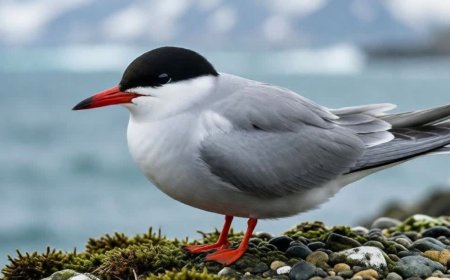
The Antarctic tern is a medium-sized tern with a white rump and a forked tail. Breeding adults have a black cap with a bright red bill, white cheeks, a grey body and black only on the outer edge of the outer primaries. The legs are red. In non-breeding plumage, the black cap disappears just behind the eyes, the underparts become white, and the bill becomes dull reddish-black. Juveniles initially have grey and white markings on the back, with distinctly yellowish flanks. The bill is dull black, and the legs are red.
Voice: "tr-tr-kria" is the main call during flight and foraging. "Chrrr" is given when defending its nest from intruders, and a high-pitched call is used to call a mate.
Similar species: Most likely to be confused with migratory Arctic terns. The latter are usually in non-breeding plumage when adult Antarctic terns are in breeding plumage. Arctic terns are generally shorter-legged and have more extensive black markings on the outer edge of the outer primaries than Antarctic terns. In addition, immature Arctic terns have a prominent black carpal band, which is absent in Antarctic terns.
Antarctic terns breed on all of the subantarctic islands of New Zealand, as well as on some of the Muttonbird Islands in southern Stewart Island. Antarctic terns do not travel far out to sea during the breeding season (September–April) and are therefore usually seen within 2 km of the breeding islands. At the northern breeding grounds (Stewart Island, Snares Islands), adults and young usually remain in coastal waters, but further south they are absent from April to October. They are presumed to be in the Southern Ocean, as there is only one accepted land record there (Aramoana, Otago, December 2023).
There are an estimated 1000 breeding pairs, but no systematic surveys have been carried out except at Snares where at least 65 breeding pairs were present during the 1980s. Populations on many breeding islands, such as Snares and Campbell, are protected in the absence of introduced mammalian predators. Rats in the Antipodes can affect breeding success. On Auckland Island, feral cats, pigs and rats are likely to be hunted for breeding success, as well as for adults and young birds.
Antarctic terns are generally colonial, although they may nest as solitary pairs or in small groups. Nests may be on bare rocky or gravelly areas or among light vegetation such as sedge or small hibiscus. The breeding season is long and varies from island to island. For example, September–March on Snares, October–March on Campbell Island, December–March on the Antipodes, and November–February on the Auckland Islands. The nest is a shallow depression or depression, usually lined with flat vegetation. The clutch size is usually 1–2. Both members of the pair incubate the eggs and feed the young.
What's Your Reaction?